CORPORATE
DATA

This site uses cookies in order to provide a higher level of service to our customers. For more information on how we use cookies, please see our Privacy Policy. If you agree to the use of cookies, please click “OK”.
OK
KENKO Investment for Health(KIH) Initiatives
KIH at JAST
KIH Declaration
In recognition of the fact that managing the promotion of employee health is a priority issue for the long-term, sustained growth of the JAST Group, we will work to maintain and improve employee health, corporate productivity and employee job satisfaction.
October 1, 2019
External evaluation
Under the Certified KENKO Investment for Health Outstanding Organizations Recognition Program promoted by the Ministry of Economy, Trade and Industry and the Nippon Kenko Kaigi aimed at recognizing outstanding organizations in the area of employee health management, JAST has been certified as a “Health and Productivity Management Outstanding Organization (large enterprise category)” since 2021.
Feedback form is here
As a company which actively works to provide high standards of support for employees’ work-life balance, JAST has been recognized with the “Platinum Kurumin” certification.
Health Promotion System
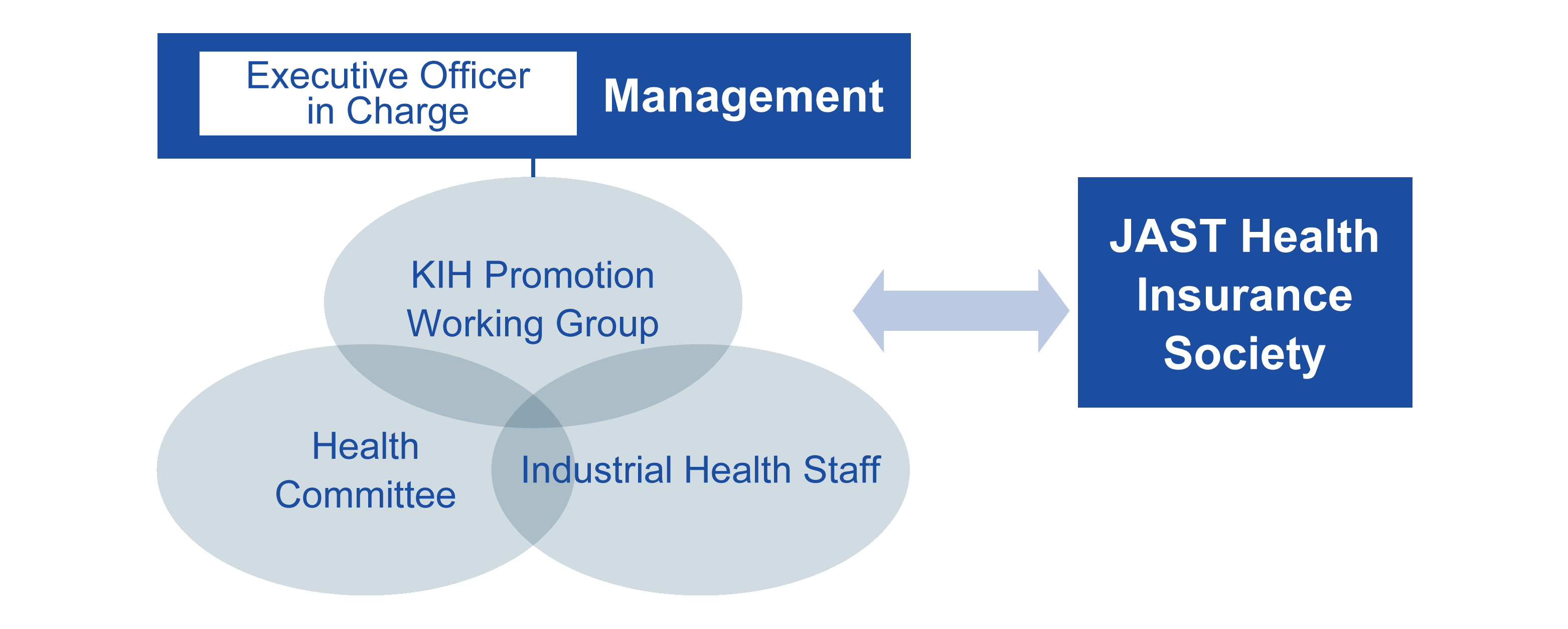
Under the leadership of the president, the KIH Promotion Office plays a central role in planning and and driving initiatives to enhance employee well-being. “KIH” stands for KENKO Investment for Health, a uniquely Japanese expression that refers to health and productivity management. In this context, “KENKO” means “health” in Japanese. In collaboration with the hygiene committee and task forces composed of representatives from each business division, the KIH Promotion Office implements programs aimed at raising health awareness, encouraging communication through wellness events, and promoting health.
The outcomes of these initiatives are reported to senior management on a monthly basis and shared with employees through internal communications as appropriate, helping to foster continuous improvement.
What is the KIH Promotion Working Group?
A working group that operates from a medium- to long-term perspective, with the project task of creating a vision of what JAST wants to achieve through KIH.
JAST’s KIH Journey
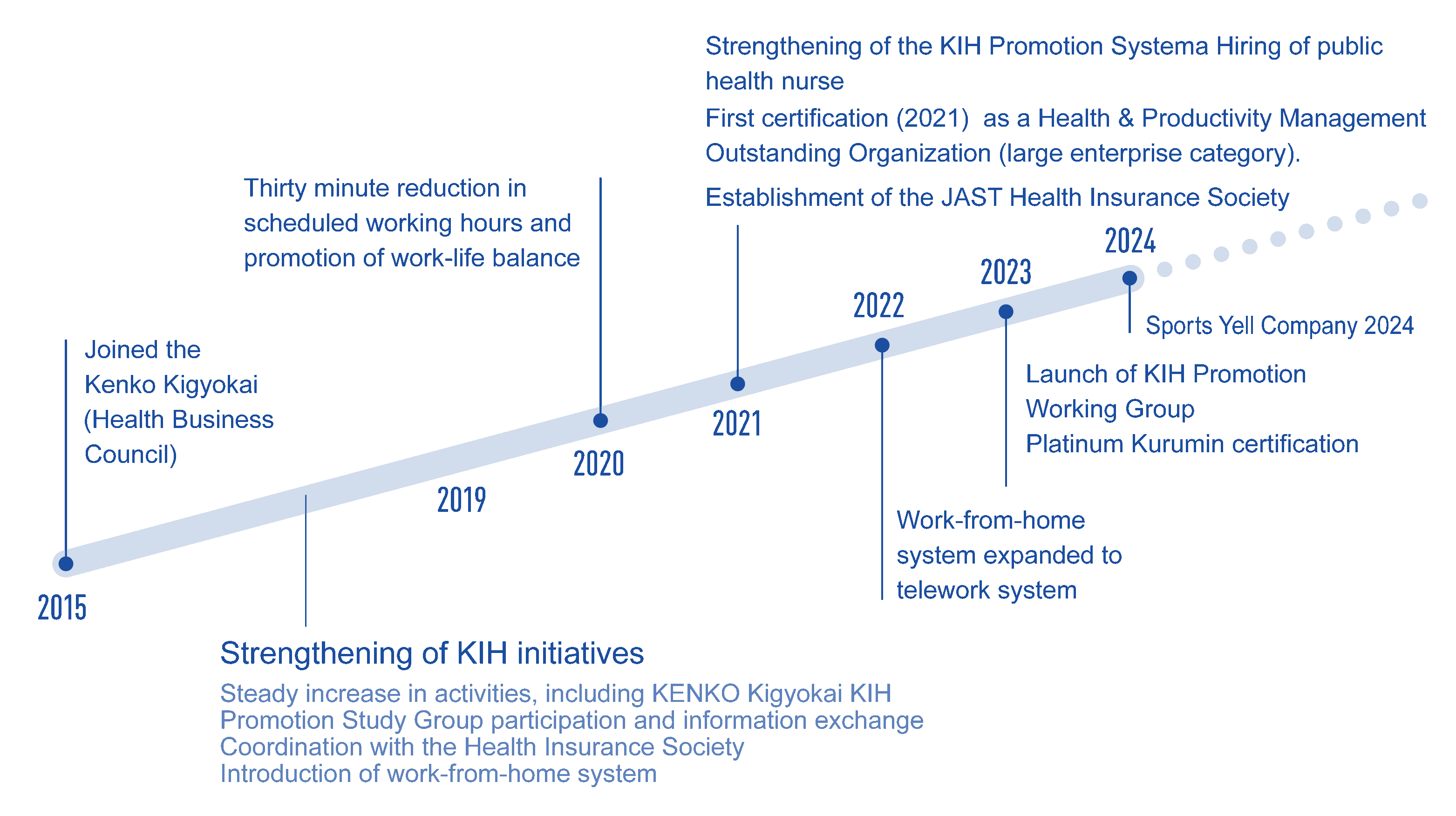
Future initiatives
- 1. We determine current challenges and utilize data-driven analysis to continuously implement the PDCA cycle that includes identifying health issues, setting KPIs, enhancing initiatives, and evaluating outcomes.
- 2. In collaboration with the JAST Health Insurance Association, we aim to enhance our workplace health management initiatives, as well as improve health promotion programs and the implementation rate of targeted health guidance.
- 3. The KIH Promotion Working Group (J-Fit) will lead discussions with our employees and conduct various interviews and consultations, as well as put into practice KIH measures to achieve a comfortable working environment.
KIH Strategy Map
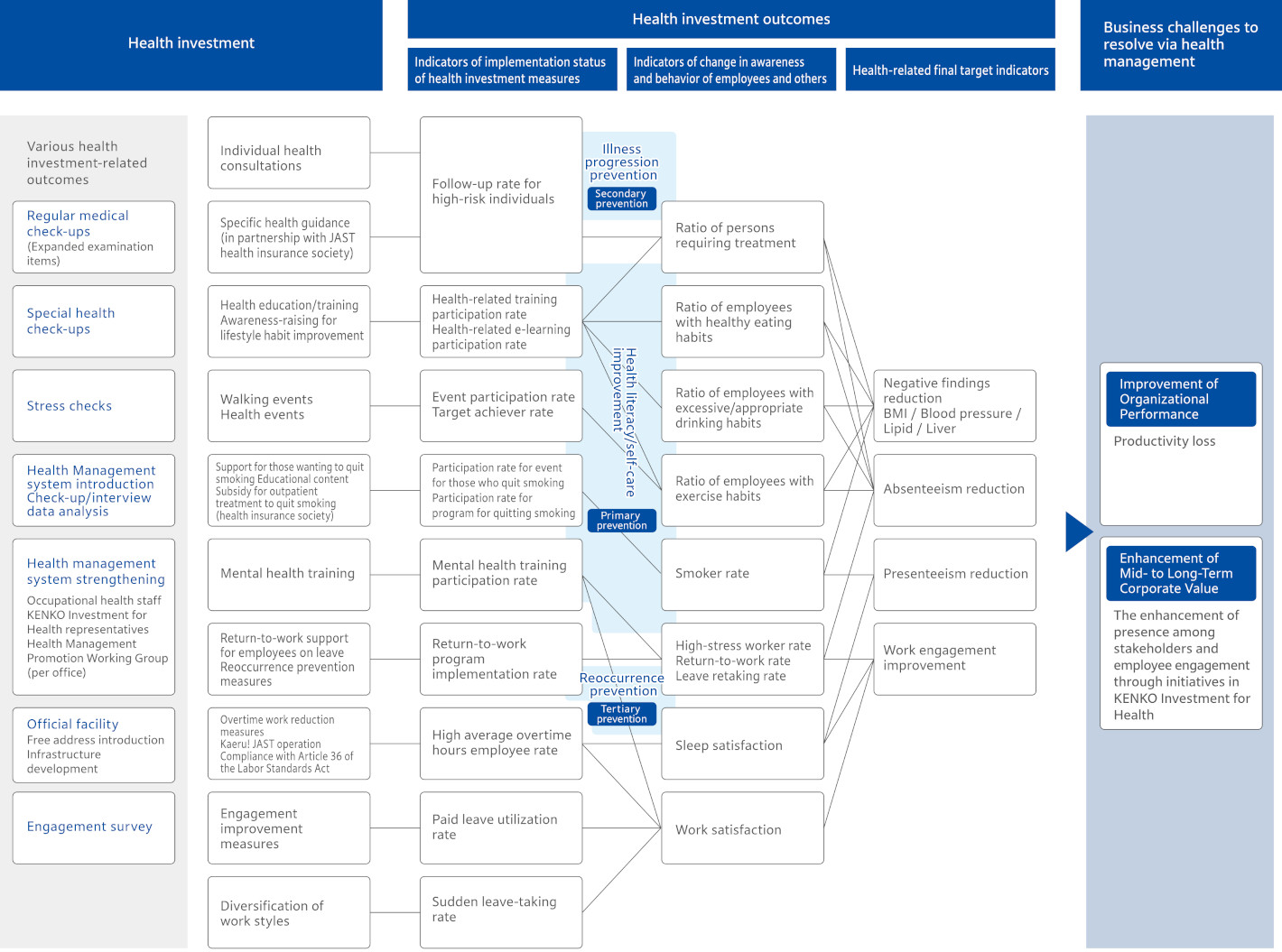
A Look at the Numbers: Initiatives and Targets (KPI)
Regular health examinations / stress checks / High stress identification rate
| 2023 | 2024 | 2025 | 2028 Target |
2035 Target |
||
|---|---|---|---|---|---|---|
| Regular health examinations | Examination rate | 100% | 100% | 100% | 100% | 100% |
| Re-examinations | 96.9% | 93.7% | 97.4% | 100% | 100% | |
| Stress checks | Testing rate | 96.6% | 96.5% | 99.3% | 100% | 100% |
| High stress identification rate | 15.2% | 12.6% | 14.8% | 13.5% | ≤12% | |
Scroll horizontally to view the table.
Average monthly total hours worked / Average monthly overtime hours worked
| 2023 | 2024 | 2025 | |
|---|---|---|---|
| Average monthly total hours worked | 162.6 | 164.7 | 164.8 |
| Average monthly overtime hours worked | 17.2 | 17.3 | 17.4 |
Scroll horizontally to view the table.
Regular working hours reduced to 7.5 hours from FY2020
Average annual paid leave utilization rate / Average annual paid leave days taken
| 2023 | 2024 | 2025 | 2028 Target |
2035 Target |
|
|---|---|---|---|---|---|
| Average annual paid leave utilization rate | 70.8% | 69.7% | 74.0% | 70% | 90% |
| Average annual paid leave days taken | 11.6 | 11.7 | 12.1 | – | – |
Scroll horizontally to view the table.
Childcare leave utilization rate / Post-childbirth return-to-work rate
| 2023 | 2024 | 2025 | 2028Target | 2035Target | |
|---|---|---|---|---|---|
| Childcare leave utilization rate (female) | 100% | 100% | 100% | 100% | 100% |
| Childcare leave utilization rate (male) | 33.3% | 90.5% | 87.5% | ≥80% | 100% |
| Mothers working one year after childbirth | 10 (out of 11) |
7 (out of 7) |
13 (out of 13) |
All mothers working one year after childbirth | Maintaining the current trend |
Scroll horizontally to view the table.
Indicators and goals for employee health data and health issues
Find more information here
KIH Measures
Creating Safe, Healthy and Employee-friendly Workplaces
Health Committee
The Health Committee reviews working hours data, shares information and opinions about seasonal topics and seeks medical advice from occupational health physicians.
Work-life balance
Annual paid leave utilization promotion
As part of our efforts to promote the use of annual paid leave, recommended days for taking paid leave are scheduled and employees are encouraged to take memorial leave for special occasions such as honeymoon periods and one’s birthday or that of a family member.
Other types of leave (unpaid)
• Healthcare leave: Leave available to employees to receive medical treatment for physical or mental symptoms related to menstruation, fertility treatment, or menopause.
• Career development leave: Leave available to employees for self-directed career development or reskilling.
• Career development leave: Leave available to employees for self-directed career development or reskilling.
Expansion of the telework system
In addition to in-office or from-home work options, we have introduced hybrid work options, like working from a relative’s home or from a satellite office, which provide employees with more choices in terms of where to work.
We also offer a remote work program to support the work-life balance of employees who are involved in childcare, caregiving, or tackling health-related issues.

Elimination of long working hours with “Kaeru! JAST”
“Kaeru! JAST” is an independently established labor practices program which has been in place at JAST since the 2009 fiscal year, and it is aimed at ensuring employees can effectively utilize their personal time, and at fostering a more relaxed workplace environment.
<Main measures>
- 1. Prohibiting, in principle, working outside of the flexible working hours period (7:00 to 22:00) and on holidays
- 2. Striving to ensure employees take at least an 11-hour rest between two consecutive working days
- 3. Establishing no overtime days in each department
- 4. Setting days in which employees are encouraged to take their annual paid leave
Short working hours system
This system is used to help employees balance their childcare (up to the third grade in elementary school) and nursing care responsibilities with their work responsibilities.
Physical Health
Expansion of health examination items
Employees are provided with subsidies from the Company and Health Insurance Society for health examinations which cover the same items as multiphasic health screenings.
Gynecological examinations are provided free of charge.
In addition, the Company and Health Insurance Society works in a partnership to provide specific health guidance.
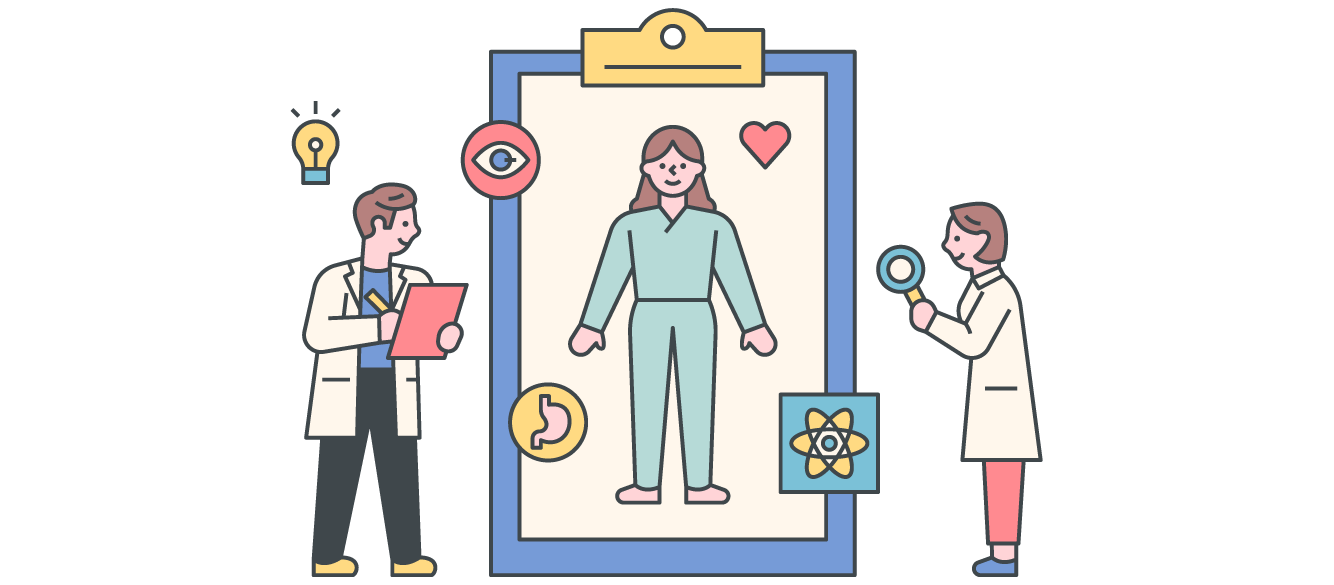
Health Education Programs
One-on-one consultations conducted by ocuupational health professionals
We provide persnalized consultations based on employees’ health checkup results.
Our goal is to empower each employee with the skills needed to make informed and appropriate health choices tailored to their individual needs.
Group education (training) / E-learning
Health management training, seminar on the topic of sleep, seminar to prepare employees for medical examinations, seminar on women’s health, etc.
Mental Health
Prevention, early detection and early treatment
Group education (training)
Self-care training for all employees, mental health training, harassment training, etc., for managers
Counseling while on leave of absence
In order to help accelerate the recovery of employees who have taken leave due to mental health struggles, as well as to prevent reoccurrences, we provide employees with regular consultations with public health nurses and licensed psychologists while on leave.
Rehabilitation program to help with returning to work
When employees return to work after a leave of absence, both they and their bosses may feel a sense of anxiousness. In order to ensure peace of mind for all parties, a support program is provided which establishes a rehabilitation period prior to an employee’s official return to work.
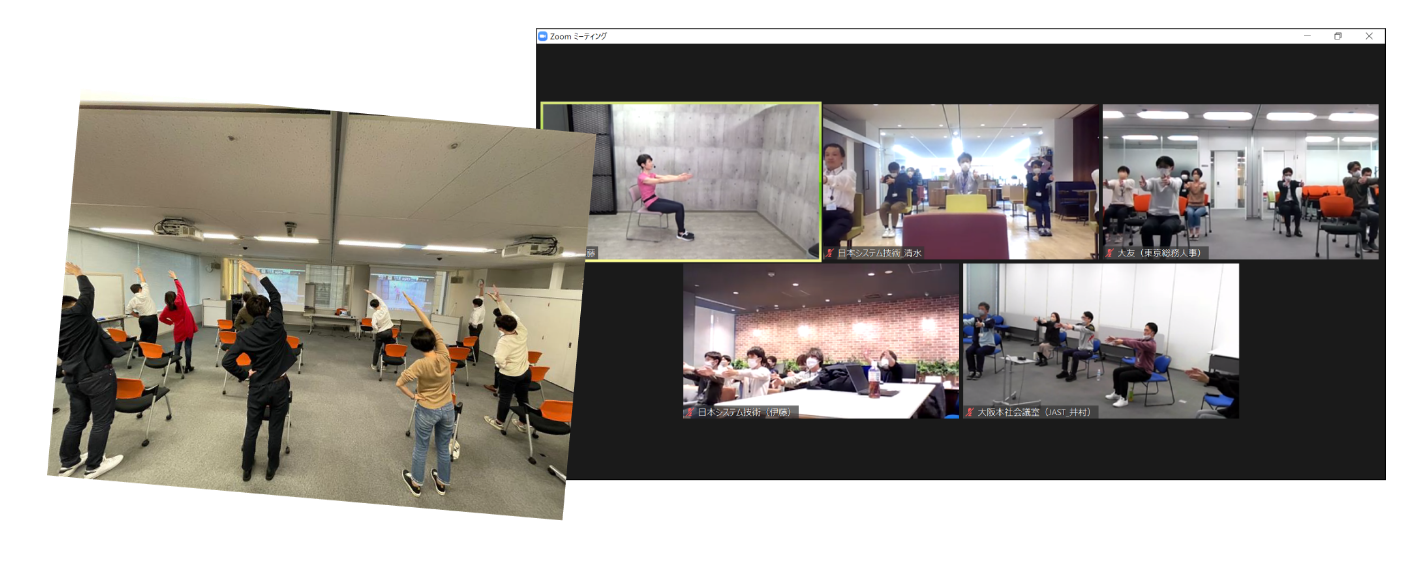
Examples of health events
Walking events
We hold walking events coordinated through a smartphone app with the aim of making walking a regular activity even for employees who often work at a desk or from home.
These events also serve to encourage workplace communication.
Walking posture assessment and locomotive syndrome checkup
We hold health-related events that employees can attend briefly at convenient times during their workday.
The aim is to improve employees’ work performance by having them establish regular exercise routines and alleviate stiff shoulders and lower back pain caused by poor posture.
Sleep measurement events
Focusing on sleep, which greatly affects work performance, we lend equipment capable of measuring blood oxygen saturation levels and brain waves to help bring about the necessary improvement.

Communication promotion
Company-wide events (futsal, volleyball, BBQs, etc.)
We host a variety of events and maintain a variety of leave systems as part of a robust framework intended to help each person live his or her best life.